

What Is a Christmas Tree in Oil and Gas? A Complete Guide to Production Assemblies
If you’ve ever stood at an active oil or gas wellsite, you’ve seen one — that vertical stack of valves, flanges, and pressure gauges rising up from the wellhead, branching outward like the limbs of a fir tree. That assembly is a Christmas tree in oil and gas production. It’s one of the most critical pieces of surface equipment in the entire oil and gas production chain, and despite the friendly name, it’s a precision-engineered, high-pressure pressure-control system that can be the difference between safe production and a catastrophic well-control incident.
For operators, engineers, procurement professionals, and anyone new to upstream operations, understanding what a Christmas tree is — and how it differs from the wellhead beneath it — is foundational. This guide breaks down the entire assembly: what it does, what the components are, the main types, and how to specify the right tree for your operation.
What Is a Christmas Tree?
A Christmas tree (also called a production tree, or simply “the tree”) is the stack of valves, chokes, gauges, and fittings installed on top of a producing oil or gas well. Its job is to control the flow of hydrocarbons out of the well and to provide isolation, monitoring, and access points for production and intervention operations. The tree sits above the wellhead — which is the lower assembly that suspends the casing and tubing — and is the primary pressure-control barrier during production.
The name comes from the visual appearance: a vertical stack of valves with branching lateral outlets that, with a bit of imagination, resembles a fir tree. The name has stuck across the global oil and gas industry for over a century.
Christmas Tree vs. Wellhead: What’s the Difference?
These two terms get conflated frequently, but they describe two distinct assemblies:
- Wellhead. The lower assembly — casing head, tubing head, hangers, and seals — that suspends the casing and tubing strings and provides pressure containment at the wellbore termination. The wellhead is installed during drilling and remains in place for the life of the well.
- Christmas tree. The upper assembly of valves, chokes, and monitoring equipment that controls production flow. The tree is installed after drilling completes (replacing the BOP stack used during drilling) and is the primary day-to-day pressure-control interface.
In short: the wellhead holds the well together; the tree controls what comes out of it. They work as a system, but they’re distinct components with distinct functions.
Anatomy of a Surface Christmas Tree
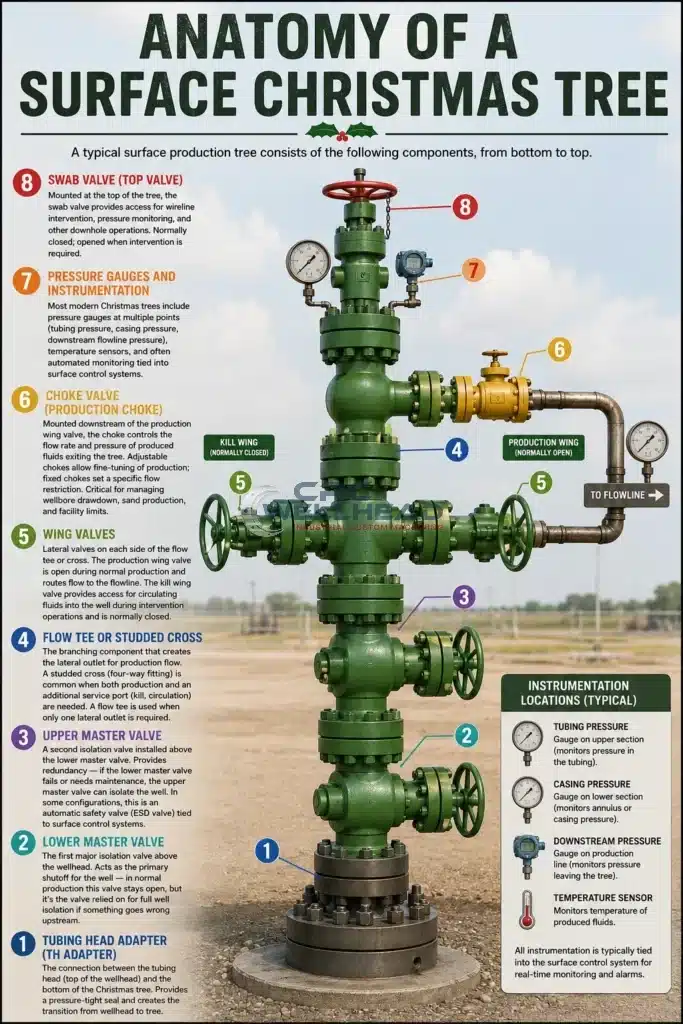
A typical surface production tree consists of the following components, from bottom to top:
- Tubing head adapter (TH adapter)
The connection between the tubing head (top of the wellhead) and the bottom of the Christmas tree. Provides a pressure-tight seal and creates the transition from wellhead to tree.
- Lower master valve
The first major isolation valve above the wellhead. Acts as the primary shutoff for the well — in normal production this valve stays open, but it’s the valve relied on for full well isolation if something goes wrong upstream.
- Upper master valve
A second isolation valve installed above the lower master valve. Provides redundancy — if the lower master valve fails or needs maintenance, the upper master valve can isolate the well. In some configurations, this is an automatic safety valve (ESD valve) tied to surface control systems.
- Flow tee or studded cross
The branching component that creates the lateral outlet for production flow. A studded cross (four-way fitting) is common when both production and an additional service port (kill, circulation) are needed. A flow tee is used when only one lateral outlet is required.
- Wing valves
Lateral valves on each side of the flow tee or cross. The production wing valve is open during normal production and routes flow to the flowline. The kill wing valve provides access for circulating fluids into the well during intervention operations and is normally closed.
- Choke valve (production choke)
Mounted downstream of the production wing valve, the choke controls the flow rate and pressure of produced fluids exiting the tree. Adjustable chokes allow fine-tuning of production; fixed chokes set a specific flow restriction. Critical for managing wellbore drawdown, sand production, and facility limits.
- Swab valve (top valve)
Mounted at the top of the tree, the swab valve provides access for wireline intervention, pressure monitoring, and other downhole operations. Normally closed; opened when intervention is required.
- Pressure gauges and instrumentation
Most modern Christmas trees include pressure gauges at multiple points (tubing pressure, casing pressure, downstream flowline pressure), temperature sensors, and often automated monitoring tied into surface control systems.
Types of Christmas Trees
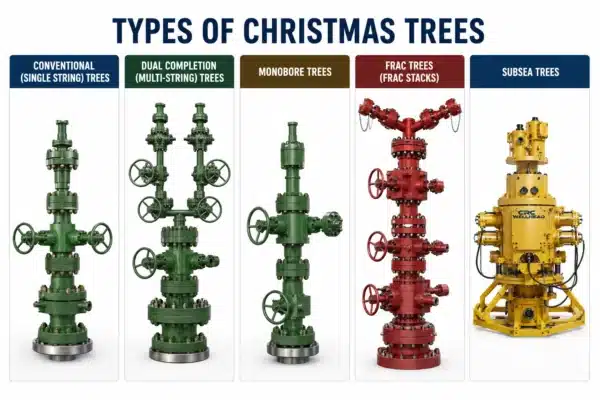
Conventional (Single String) Trees
Standard configuration with a single tubing string and single production path. Most onshore oil and gas wells in Western Canada use conventional trees. Manufactured to API 6A standards and rated from 2,000 psi to 20,000 psi (and higher in extreme service).
Dual Completion (Multi-String) Trees
Configured for wells producing from multiple zones through separate tubing strings. More complex and more expensive than conventional trees, but allow separate production accounting and control for each zone.
Monobore Trees
Simplified trees designed for monobore wells where a single casing/tubing string runs from surface to total depth. Lower cost and smaller footprint, suited to low-pressure gas and slim-hole completions.
Frac Trees (Frac Stacks)
Heavy-duty, high-pressure trees specifically built for hydraulic fracturing operations. Typically rated 10,000–15,000 psi or higher, with reinforced bodies, abrasion-resistant trim, and goat heads or zipper manifolds at the top for multi-stage frac connections. Installed as temporary equipment during the frac job and replaced with a conventional production tree once fracturing is complete.
Subsea Trees
Engineered for installation on the seafloor for offshore wells. Substantially more complex than surface trees, with hydraulic actuation, ROV interfaces, and seawater-rated materials. Not common in Canadian onshore operations but standard for offshore developments.
How a Christmas Tree Is Specified
Tree specification depends on several interdependent variables:
- Pressure rating (API class). Standard API 6A classes: 2K, 3K, 5K, 10K, 15K, 20K psi. Select based on maximum anticipated wellhead pressure with appropriate safety margin.
- Bore size. Must match the wellhead bore size and the production tubing string. Common surface tree bore sizes range from 1-13/16″ to 7-1/16″ depending on application.
- Service environment. Sweet vs. sour service (NACE MR0175), temperature range, CO₂ content, and corrosive fluid exposure all drive material grade selection. Common materials include AISI 4130, 4140, and 8630 forged steel; exotic alloys for severe service.
- Valve configuration. Manual gate valves are standard; hydraulic-actuated valves are used for ESD systems and remote-operation requirements.
- Flange and connection types. RTJ (ring-type joint) faces dominate API 6A trees. Connection sizes must match the wellhead underneath and the flowline downstream.
- Regulatory compliance. API 6A is the global standard. Provincial regulations (AER in Alberta, BCER in BC) may impose additional requirements.
Why Christmas Tree Selection Matters
- Pressure rating mismatched to actual wellhead pressure can lead to catastrophic failure
- Inadequate material grade in sour service can fail rapidly from sulphide stress cracking
- Wrong bore size limits production capacity and can cause turbulence or erosion
- Manual valves on a remote well that should be automated extends emergency response times
- Misspecified choke valve restricts production or causes premature erosion
The cost of getting the tree wrong — in downtime, equipment damage, or worse — far exceeds the cost of getting it right the first time. Always work with a qualified supplier who understands API 6A, provincial regulations, and your specific well conditions.
Frequently Asked Questions About Christmas Trees
Why is it called a “Christmas tree”?
The name comes from the visual appearance of the assembly — a vertical stack of valves with branching lateral outlets that resembles a fir tree. The term has been used in the oil and gas industry for over a century and is now standard global terminology.
How much does a Christmas tree cost?
Surface trees range from $25,000–$50,000 for basic 5K psi conventional configurations to $200,000+ for 15K/20K sour-service trees with full instrumentation. Frac trees, subsea trees, and high-spec configurations can run substantially higher. Always specify carefully — over-spec’ing wastes money; under-spec’ing creates safety and operational risk.
How long does a Christmas tree last?
Properly specified and maintained, a Christmas tree can serve the entire 20+ year life of a producing well. Periodic inspection, valve maintenance, and seal replacement extend service life. Frac trees, by contrast, are temporary and used only during the fracturing operation.
What’s the difference between a master valve and a wing valve?
Master valves are stacked vertically above the wellhead and provide primary well isolation — they control flow up the tubing string. Wing valves are mounted laterally on the flow tee or cross and control flow into and out of the lateral production and kill ports.
Why are there two master valves on most trees?
Redundancy. If the lower master valve fails or needs maintenance, the upper master valve still provides isolation. Many regulatory regimes require dual barriers for primary pressure containment, and dual master valves satisfy this requirement.
What’s a frac tree?
A frac tree is a heavy-duty Christmas tree designed specifically for hydraulic fracturing. Typically rated 10K–15K psi or higher, with abrasion-resistant trim and goat-head or zipper-manifold connections at the top for multi-stage frac operations. Installed temporarily for the frac job and replaced with a conventional tree once fracturing is complete.
Can a Christmas tree be refurbished and reused?
Yes — major components like bodies, bonnets, and bonnets can often be refurbished and re-certified for service. Refurbishment must follow strict API and regulatory requirements including inspection, NDE (non-destructive examination), and recertification.
Where can I source Christmas tree components in Western Canada?
CRC Wellhead supplies Christmas tree components — flanges, adapters, studded crosses, spool adaptors, and custom-machined parts — from our Edmonton facility. We serve operators across Alberta, BC, Saskatchewan, and beyond. Contact our team for component-specific or full tree assembly requirements.
Need Christmas Tree Components for Your Operation?
CRC Wellhead specializes in machining and supplying wellhead and Christmas tree components for the Western Canadian oil and gas industry. From companion flanges and studded crosses to spool adaptors and custom-machined assemblies, our team supports operators across the lifecycle of the well.
Contact us with your project requirements for a quote, or visit our Edmonton facility to discuss your operation.