

What Is a Studded Cross? The Compact Alternative to Flanged Manifolds
In high-pressure oil and gas systems, space, weight, and reliability are critical design considerations. One component that addresses all three is the studded cross—a compact, high-strength alternative to traditional flanged manifold connections.
If you’re evaluating surface equipment components, understanding what a studded cross is and how it compares to flanged designs can help improve system efficiency and reduce structural load. This guide explains the design, function, and advantages of an API 6A studded cross, with a focus on why it is widely used as a wellhead manifold block.
What Is a Studded Cross?
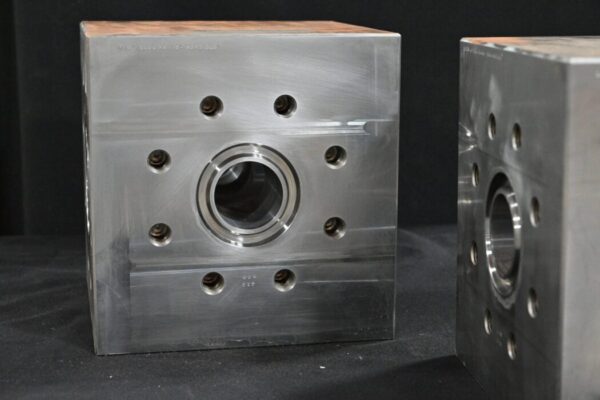
A studded cross is a solid, pressure-rated block used in wellhead and surface equipment assemblies. It features four intersecting outlets (forming a cross shape), each designed for connection to valves, flowlines, or other pressure control components.
Unlike traditional flanged crosses, a studded cross uses a “studded” connection design, where stud bolts are threaded directly into the body of the block rather than passing through flange holes.
This design eliminates the need for separate mating flanges, making the studded cross more compact and structurally efficient.
What Does “Studded” Mean in Design?
The term “studded” refers to how connections are made.
Studded Design
-
Stud bolts are threaded directly into tapped holes in the cross body
-
Components are bolted directly onto the block
-
No additional flange thickness is required
Flanged Design (for comparison)
-
Bolts pass through two separate flanges
-
Requires mating flange pairs
-
Adds extra spacing, weight, and connection points
This distinction is central to understanding studded vs flanged cross configurations.
Studded Cross vs Flanged Cross: Key Differences
When comparing a studded vs flanged cross, the primary differences lie in size, weight, and structural design.
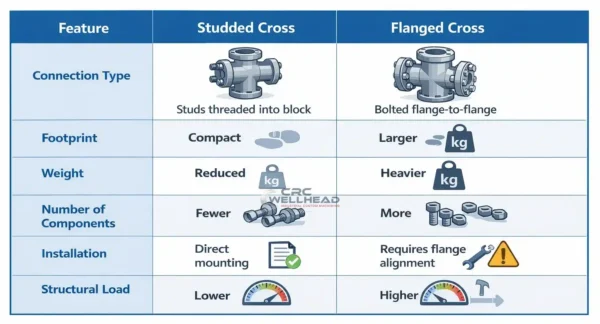
Because studded crosses eliminate additional flange interfaces, they offer a more streamlined and efficient design.
Why Studded Crosses Reduce Footprint and Weight
One of the biggest advantages of an API 6A studded cross is its ability to minimize both space requirements and overall system weight.
1. Compact Design
By removing the need for separate flanges, studded crosses:
-
Reduce overall assembly height
-
Minimize spacing between components
-
Fit more easily into tight wellhead configurations
This is especially valuable in offshore platforms or confined installations.
2. Lower Weight on the Wellhead
Flanged connections add extra metal, increasing total system weight. Studded crosses reduce this by:
-
Eliminating flange pairs
-
Reducing bolt length and hardware
-
Consolidating connections into a single block
Lower weight means less stress on the wellhead structure, which improves long-term system integrity.
3. Fewer Leak Paths
Each flange interface introduces a potential leak point. Studded crosses:
-
Reduce the number of sealing surfaces
-
Minimize gasket interfaces
-
Improve overall pressure containment
This contributes to safer and more reliable operation.
Applications of Studded Crosses in Wellhead Systems
Studded crosses are commonly used as wellhead manifold blocks, where multiple flow paths must be controlled and distributed efficiently.
Typical applications include:
-
High-pressure wellhead assemblies
-
Flowline distribution systems
-
Choke and kill manifolds
-
Production flow routing
-
Pressure control systems
Their compact design makes them ideal for systems where space and weight are limited.
API 6A Studded Cross: Standards and Performance
An API 6A studded cross is manufactured according to strict industry standards that define:
-
Pressure ratings
-
Material requirements
-
Dimensional tolerances
-
Testing procedures
-
Temperature classifications
API 6A compliance ensures compatibility with other pressure-rated equipment and guarantees performance in demanding oilfield environments.
Materials and Manufacturing Considerations
Studded crosses are typically manufactured from:
-
Carbon steel
-
Alloy steel
-
Stainless steel (for corrosion resistance)
Precision machining is critical to ensure:
-
Accurate thread engagement
-
Proper sealing surfaces
-
Correct alignment of outlets
-
Reliable pressure containment
High-quality machining directly impacts safety, durability, and long-term performance.
Advantages of Using a Studded Cross
Choosing a studded cross offers several operational benefits:
-
Compact footprint
-
Reduced weight on the wellhead
-
Fewer components and connections
-
Lower risk of leaks
-
Easier installation in tight spaces
-
High strength and pressure capability
These advantages make studded crosses a preferred solution in modern wellhead system design.
Why Studded Crosses Matter
A studded cross is a compact, high-strength wellhead manifold block designed to simplify connections while maintaining pressure integrity. Compared to traditional flanged designs, the studded vs flanged cross approach offers reduced footprint, lower weight, and fewer potential leak paths.
For operators and engineers, selecting an API 6A studded cross improves efficiency, enhances safety, and supports better system performance—especially in high-pressure, space-constrained environments.
CRC Wellhead Supply
CRC Wellhead Supply manufactures precision-machined API 6A studded crosses, adapter spools, and custom wellhead components designed for strength, accuracy, and reliability. With advanced CNC and manual machining capabilities, CRC delivers high-performance solutions that reduce system weight while maintaining pressure integrity.
Contact CRC Wellhead Supply today to discuss your studded cross requirements or request a custom machining solution tailored to your wellhead system