
Standard Blind vs. Test Blind Flanges: Which Type Do You Need?
In high-pressure piping and wellhead operations, “closing the loop” is a matter of safety and certification. While they may look similar at a glance, choosing between different blind flange types depends entirely on whether you are looking for permanent isolation or a temporary testing solution.
At CRC Wellhead Supply, we specialize in machining both standard and specialized blinds with a 3,000 lb capacity, ensuring your system remains leak-proof under the most demanding Canadian oilfield conditions.
The Standard Blind Flange: Permanent Isolation
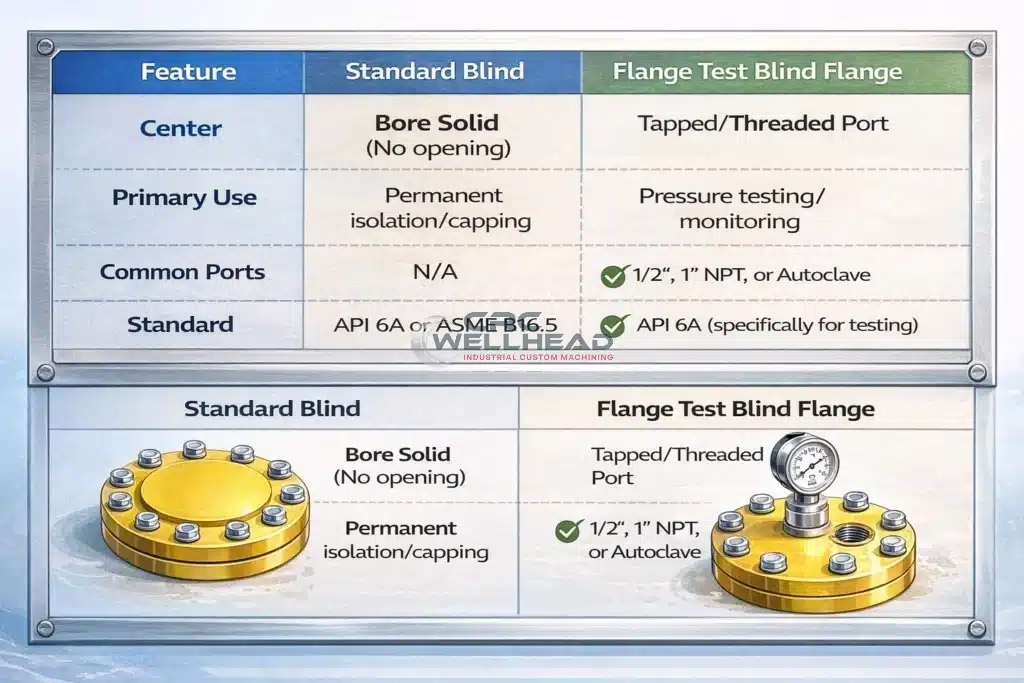
A standard blind flange is a solid piece of machined steel with no center bore. Its sole purpose is to terminate a piping system or seal off a section of the wellhead.
When to Use It:
-
System Termination: To safely cap off a line that is no longer in use or waiting for future expansion.
-
Maintenance Isolation: To “blind off” a section of a vessel or Christmas tree so that downstream work can be performed safely.
-
Pressure Containment: As a primary barrier in high-pressure assemblies.
Common Interface Types:
-
RTJ (Ring Type Joint): The gold standard for API 6A equipment. It features a precision-machined groove for a metal ring gasket, creating a metal-to-metal seal.
-
Raised Face (RF): Common in lower-pressure industrial piping where a serrated face grips a composition gasket.
The Test Blind Flange: The Certification Tool
Unlike a standard blind, a test blind flange (also known as a tapped blind) features one or more threaded ports—typically NPT or Autoclave—machined into the center or side of the flange.
When to Use It:
-
Hydrostatic Testing: The port allows technicians to pump water or hydraulic fluid into a sealed system to test for leaks.
-
Pressure Monitoring: It provides a temporary mounting point for pressure gauges or sensors during well intervention.
-
Venting & Bleeding: The port acts as a “bleed-off” point to safely release trapped pressure before the flange is removed.
Key Differences: Standard vs. Test Blinds
The CRC Advantage: Custom Machining & Materials
Choosing the right blind flange types is only half the battle; the quality of the machining determines the safety of the seal. At CRC Wellhead Supply, we elevate your hardware through:
-
Heavy-Duty Capacity: We machine blinds up to 3 feet in diameter and 3,000 lbs in weight.
-
Extreme Service Materials: For sour gas (H2S) environments, we offer 316 Stainless Steel or CRA-clad blinds to prevent hydrogen embrittlement.
-
Precision Ring Grooves: Our CNC and manual experts ensure that every RTJ groove is machined to exact API tolerances, preventing the costly leaks that lead to downtime.
Whether you need the permanent security of a solid RTJ blind or the functional versatility of a test blind flange, understanding these blind flange types ensures your project meets safety and regulatory standards.
Don’t settle for “off-the-shelf” parts for high-pressure applications. Contact CRC Wellhead Supply today for a custom machining quote on API-certified blind and test flanges built to your exact specifications.