

What Is Wellhead Pressure? The Difference Between Shut-In and Flowing Pressure
In oil and gas production, pressure tells the real story of a well’s condition. Understanding what is wellhead pressure is fundamental for safe operations, production optimization, and rigorous well control management.
At its core, wellhead pressure refers to the force measured at the surface where the wellbore meets surface equipment. These readings provide immediate insight into reservoir performance, flow behavior, and potential safety risks. To properly manage a well, it’s essential to distinguish between two critical measurements:
-
SIP (Shut-In Pressure): Pressure when the well is closed.
-
FTP (Flowing Tubing Pressure): Pressure when the well is producing.
Monitoring these values is the first line of defense in well control.
What Is Wellhead Pressure?
Wellhead pressure is the measurement taken at the wellhead assembly, typically at the tubing head or Christmas tree valves. It represents the force exerted by fluids (oil, gas, water, or a mixture) within the wellbore against the surface containment.
This pressure is influenced by several variables:
-
Reservoir energy and fluid density.
-
Flow rate and choke settings.
-
Surface restrictions and tubing configuration.
Accurate wellhead monitoring ensures that operators can quickly detect abnormalities such as pressure buildup, formation issues, or flow restrictions before they become hazardous.
Understanding Shut-In Pressure (SIP)
What Is Shut-In Tubing Pressure?
Shut-in tubing pressure (SIP or SITP) is the pressure recorded at the wellhead when the well is completely closed and not producing. When all valves are shut and fluid movement stops, the pressure stabilizes.
Why Shut-In Pressure Matters:
SIP reflects static reservoir conditions. It provides vital data on reservoir energy, formation pressure trends, and overall well integrity. If SIP rises unexpectedly, it may indicate gas migration, casing integrity issues, or reservoir recharge. Because it represents “stored energy,” it is a primary indicator for diagnosing well behavior.
Understanding Flowing Tubing Pressure (FTP)
What Is Flowing Wellhead Pressure?
Flowing tubing pressure (FTP)—often referred to as flowing wellhead pressure—is the measurement taken while the well is actively producing.
Why Flowing Pressure Is Critical:
When the well is flowing, fluids move up the tubing, and pressure drops due to friction and flow dynamics. Consequently, FTP is typically lower than SIP. Monitoring this allows operators to:
-
Optimize production rates and adjust choke settings.
-
Identify downhole restrictions or scale buildup.
-
Detect early warning signs of well instability or tubing leaks.
Shut-In vs. Flowing Pressure: A Clear Comparison
Understanding the difference between shut-in tubing pressure and flowing wellhead pressure is central to practical well management.
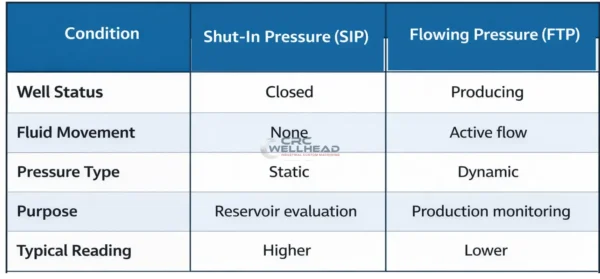
In simple terms:
-
Shut-In Pressure = Stored energy
-
Flowing Pressure = Energy under use
Both measurements provide complementary data necessary for safe and efficient operations.
The Role of Surface Equipment in Pressure Management
Reliable pressure readings depend on high-quality surface equipment components. Wellheads and Christmas trees must maintain absolute pressure integrity and leak-free seals to ensure gauge accuracy.
At CRC Wellhead Supply, we manufacture precision-machined parts that support these high-pressure environments:
-
Adapter Spools: Ensuring safe, pressure-rated transitions between different system sizes.
-
Companion Flanges: Providing the robust bolted interface required to mate the Christmas tree to the wellhead.
-
7 1/16″ Male Pins: Precision-threaded to withstand the constant stress of flowing or shut-in conditions.
Our 3,000 lb machining capacity and API 6A compliance ensure that your foundation is as strong as the pressure it contains.
Why Wellhead Pressure Matters
So, what is wellhead pressure? It is the direct indicator of your reservoir’s health and your system’s safety. The key difference between shut-in tubing pressure and flowing wellhead pressure lies in static versus dynamic conditions—one measures potential, while the other reflects performance.
Monitoring both values is your first line of defense, helping you catch abnormalities early and maintain safe operating conditions.
Need to upgrade your pressure containment hardware?
Contact CRC Wellhead Supply today for a quote on API-certified spools, flanges, and custom components designed for maximum reliability.